
Finding the best dog bed for a large dog is about more than choosing the biggest bed you can find. Large breeds need enough sleeping space, reliable support, durable materials, and a bed that is easy to keep clean. In this guide, we explain what to look for when choosing a dog bed for a large breed and how to compare the available options before buying.
What to Look for in a Dog Bed for Large Dogs
A good bed should give your dog a comfortable place to rest without creating unnecessary work for you. The right choice will depend on your dog’s size, sleeping habits, age, activity level, and your home environment.
Large dogs place more weight and pressure on a bed than smaller breeds. A bed that looks thick and comfortable when new may flatten quickly if its internal materials are not designed to support a heavier dog.
Here are the most important factors to consider.
1. Choose the Right Size
Size and sleeping space matter. Your dog should be able to lie down, stretch out, and change sleeping positions without hanging over the edges of the bed.
Before buying, measure your dog from the nose to the base of the tail while resting. You should also consider how your dog normally sleeps.
A dog that curls into a tight ball may be comfortable on a smaller sleeping surface, while a dog that likes to stretch out will need considerably more room.
Do not rely entirely on labels such as Large, XL, or XXL. These sizes can vary between manufacturers. Always check the actual dimensions of the bed.
2. Look for Adequate Support
Support is particularly important for large and heavy dogs.
Very soft beds can initially feel comfortable but may compress under your dog’s weight. Once compressed, the bed may provide little separation between your dog and the floor.
Look at both the thickness and the material used inside the bed.
Memory foam and other supportive foam constructions are commonly used in beds designed for larger dogs. Some beds use several layers, with a supportive base underneath a softer comfort layer.
When comparing products, check whether the manufacturer provides information about foam thickness and construction rather than relying only on words such as “orthopedic.”
3. Consider Your Dog’s Age and Mobility
Your dog’s age can influence the type of bed that is most practical.
A young, active dog may be comfortable with many different designs. An older dog or a dog that finds climbing difficult may benefit from a bed with a low entry point.
Beds with very high sides can provide a cozy sleeping environment, but they may be more difficult for some dogs to enter and leave.
If your dog has mobility difficulties or a medical condition, a veterinarian can help you determine whether a particular sleeping arrangement would be appropriate.
4. Check the Quality of the Cover
The cover is one of the most important parts of a dog bed because it receives daily exposure to fur, dirt, moisture, and scratching.
Look for a cover made from material that can tolerate regular use.
A removable cover is particularly convenient because you can wash it separately rather than trying to clean the entire bed.
Before buying, check the manufacturer’s washing instructions. Some covers are machine washable, while others require more careful cleaning.
5. Look for a Waterproof or Water-Resistant Layer
Accidents happen.
Water, urine, mud, and other liquids can penetrate a bed and reach the foam inside. Foam is considerably more difficult to clean and dry than a removable fabric cover.
For this reason, a waterproof or water-resistant liner around the internal foam can be valuable.
Pay attention to the terminology used by manufacturers. “Water-resistant” does not necessarily mean completely waterproof.
If liquid protection is important to you, check exactly which part of the bed is protected and whether the protective liner can also be removed or cleaned.
6. Consider Durability
Large dogs can be demanding on bedding.
Claws, digging, repeated movement, and the dog’s weight can gradually damage fabric, seams, zippers, and foam.
Look closely at the construction of the bed, particularly:
- Cover material
- Stitching
- Zipper quality
- Foam density and thickness
- Reinforced edges
- Replacement-cover availability
However, no ordinary dog bed should automatically be considered chew-proof.
If your dog regularly destroys bedding, durability should be a major consideration, and you should follow the manufacturer’s guidance regarding appropriate use.
7. Think About Your Dog’s Sleeping Style
Dogs have different sleeping preferences.
Some love curling against raised sides. Others prefer stretching across a completely flat surface.
Watching how your dog currently sleeps can tell you a lot about which bed design may work best.
Flat or Mattress-Style Beds
These provide an open sleeping surface and can work well for dogs that like to stretch.
They are also usually easy to approach from different sides.
Bolster Beds
Bolster beds have raised edges around part or most of the sleeping area.
Dogs that like resting their heads against something may enjoy this design.
Remember that the external dimensions of a bolster bed can be misleading. The raised sides reduce the actual sleeping area, so check the internal dimensions.
Sofa-Style Beds
These resemble small sofas, usually combining a foam base with raised sides.
They can provide both an open entrance and something for the dog to lean against.
Elevated Dog Beds
Elevated beds raise the sleeping surface above the floor.
Their open construction can provide airflow underneath the dog and may be useful in warmer environments or outdoor settings when the product is designed for such use.
They feel quite different from foam beds, so your dog’s preferences matter.
8. Consider Temperature and Climate
A thick, heavily padded bed may be comfortable in a cool room but less appealing to some dogs in hot weather.
Large dogs with thick coats may prefer cooler sleeping surfaces.
If you live in a warm climate, consider airflow, fabric type, and whether the bed retains excessive heat.
An elevated bed may be worth considering for dogs that prefer increased airflow, while other dogs may still prefer the cushioning of foam.
9. Look for a Non-Slip Bottom
Large dogs can push a lightweight bed across a smooth floor simply by stepping onto it.
A non-slip or textured base can help keep the bed more stable on tile, laminate, hardwood, and other smooth surfaces.
This feature may be particularly useful when the bed is used by an older dog that needs stable footing when getting up.
10. Make Sure the Bed Is Easy to Clean
Even the best-looking dog bed can become frustrating if it is difficult to maintain.
Dogs bring hair, dirt, saliva, and sometimes mud onto their beds. Regular cleaning is therefore part of normal pet-bed ownership.
Before purchasing, check:
- Whether the cover is removable
- Whether it is machine washable
- Whether the internal liner can be cleaned
- Whether replacement covers are available
- Whether hair is easy to remove from the fabric
- The manufacturer’s drying instructions
A practical bed should fit both your dog’s needs and your cleaning routine.
How to Measure Your Large Dog for a Bed
Choosing the correct dimensions is easier if you measure your dog first.
Wait until your dog is lying naturally in a preferred sleeping position.
Measure approximately from the nose to the base of the tail. If your dog usually stretches its legs outward, account for the additional space required.
Then compare your measurements with the manufacturer’s stated sleeping-area dimensions.
This distinction is important with bolster beds because a product might have large external dimensions while providing a much smaller internal sleeping surface.
When your dog’s measurement falls close to the maximum dimensions of a particular size, choosing the larger option may provide more room to move.
Memory Foam vs. Regular Foam Dog Beds
One of the most common decisions when shopping for a large dog bed is choosing between memory foam and conventional foam.
Memory Foam
Memory foam responds to pressure and conforms to the shape placed on it.
Its performance depends on factors such as thickness, density, overall construction, and the weight placed on the bed.
A thin layer of memory foam over an inadequate base may not provide the same experience as a properly constructed multi-layer bed.
Conventional Foam
Standard foam can also provide cushioning and support. Quality varies significantly among products.
The important question is not simply whether a product contains memory foam. You should consider the entire construction of the bed.
Check the thickness, number of layers, specifications provided by the manufacturer, and whether the product is designed for dogs of your dog’s approximate weight.
Orthopedic Dog Beds: What Does the Term Mean?
You will frequently see dog beds advertised as “orthopedic.”
The term is commonly used for beds designed to provide additional cushioning or support, often using foam.
However, you should evaluate the actual construction rather than making a buying decision based only on the word orthopedic.
Look for specific information about:
- Foam type
- Foam thickness
- Layer construction
- Bed dimensions
- Recommended dog sizes or weights
- Cover design
- Ease of entry
If your dog has arthritis, joint problems, pain, or another medical condition, speak with your veterinarian about your dog’s individual needs.
A dog bed is not a substitute for veterinary diagnosis or treatment.
What Size Bed Does a Large Dog Need?
There is no single correct bed size for every large dog.
Breed labels are useful as a starting point, but dogs within the same breed can vary significantly in size.
Your dog’s individual measurements and sleeping habits are more useful than relying solely on breed recommendations.
Large breeds may include dogs such as:
- German Shepherds
- Golden Retrievers
- Labrador Retrievers
- Rottweilers
- Doberman Pinschers
- Great Danes
- Mastiffs
- Saint Bernards
Some of these breeds differ enormously in adult size, which is another reason to check actual product measurements carefully.
Features Worth Paying Extra For
The most expensive dog bed is not automatically the best choice.
Instead, consider paying more when the additional cost provides a feature that is genuinely useful for your dog.
Potentially valuable features include:
Thicker supportive foam: Particularly relevant for heavier dogs.
Removable washable covers: Useful for long-term maintenance.
Waterproof internal liners: Helps protect foam from moisture.
Replacement covers: Can extend the usable life of the bed.
Non-slip bases: Useful on smooth floors.
Strong zippers and seams: Important for regular use by larger dogs.
Low-entry designs: Potentially useful for dogs that have difficulty stepping over high sides.
Focus on the features your dog actually needs rather than choosing the product with the longest list of marketing claims.
Pawfty may earn a commission from purchases made through links on this page. As an Amazon Associate, Pawfty earns from qualifying purchases.
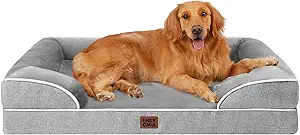
EHEYCIGA Orthopedic Extra Large Dog Bed, 44-Inch
Best for: Large and extra-large dogs
Supportive 44-inch orthopedic dog bed for large and extra-large dogs, featuring egg-crate foam, raised sides, a waterproof layer, and a removable washable cover.
Check current price
View on AmazonCommon Mistakes When Buying a Large Dog Bed
Buying Based Only on Breed
Two dogs of the same breed can have different body sizes and sleeping habits.
Measure your individual dog.
Looking Only at External Dimensions
This is especially problematic with bolster beds.
Always check the usable sleeping area.
Choosing the Cheapest Bed Without Considering Durability
An inexpensive bed that quickly flattens or tears may ultimately cost more if it needs frequent replacement.
Price should be considered alongside construction and expected use.
Assuming Every Expensive Bed Is Better
Higher prices do not automatically guarantee better suitability.
Compare specifications, materials, dimensions, cleaning requirements, warranty information, and customer feedback.
Ignoring Cleaning Instructions
A difficult-to-clean bed can quickly become inconvenient.
Check maintenance requirements before buying.
Assuming “Orthopedic” Guarantees Medical Benefits
Focus on actual construction and your dog’s needs rather than marketing terminology.
For medical concerns, consult your veterinarian.
How Much Should You Spend on a Large Dog Bed?
Dog beds for large breeds are available across a wide price range.
Rather than choosing a bed based on price alone, consider the total value you receive.
A more expensive bed may make sense when it includes a substantial foam base, washable cover, waterproof liner, replacement-cover options, and a useful warranty.
On the other hand, you may not need premium features for a young dog that simply needs a comfortable everyday sleeping area.
Set your budget after identifying the features that matter most.
How to Compare Dog Beds Before Buying Online
Online shopping gives you access to many options, but product photographs can make beds appear larger or thicker than they really are.
Before buying, compare several pieces of information:
- Actual external dimensions
- Internal sleeping dimensions
- Foam thickness
- Materials
- Cleaning instructions
- Maximum recommended weight, if provided
- Warranty or return information
- Recent customer reviews
Reviews can be particularly useful for identifying recurring issues such as flattening foam, weak zippers, inaccurate sizing, difficult assembly, or covers that are hard to replace.
Do not rely on one review alone. Look for patterns across a substantial number of recent reviews.
Frequently Asked Questions
Are memory foam beds good for large dogs?
Memory foam can provide cushioning and pressure distribution, but quality and construction vary between products. Consider foam thickness, density where disclosed, the supporting layers, and whether the bed is appropriate for your dog’s size and weight.
How thick should a dog bed be for a large dog?
There is no universal thickness that is ideal for every large dog. Heavier dogs generally require enough supportive material to prevent them from easily compressing the bed to the floor. Evaluate thickness together with foam type and construction.
Should a dog bed be bigger than the dog?
The sleeping area should provide enough room for your dog to rest naturally and change positions comfortably. Dogs that stretch out generally need more space than dogs that sleep curled up.
Are elevated beds good for large dogs?
They can be useful for some dogs, particularly when airflow and keeping the dog off the floor are priorities. However, comfort preferences vary, and dogs with mobility difficulties may require additional consideration.
How often should I wash my dog’s bed?
There is no single schedule appropriate for every household. Cleaning frequency depends on shedding, outdoor activity, allergies, accidents, odor, and the manufacturer’s instructions. Wash the cover whenever necessary to keep the sleeping area hygienic.
Do large dogs need orthopedic beds?
Not every large dog requires a bed marketed as orthopedic. What matters is providing adequate comfort and support for the individual dog. Dogs with diagnosed joint or mobility problems should be evaluated by a veterinarian.
Final Thoughts
The best dog bed for a large dog is not necessarily the most expensive or the one with the most impressive advertising. It is the bed that provides enough space for your dog, appropriate support, durable construction, and practical cleaning features.
Start by measuring your dog and observing how it normally sleeps. Then compare the actual dimensions, materials, foam construction, cover, moisture protection, and maintenance requirements of the beds you are considering.
Taking a few minutes to compare these details can help you choose a bed that is comfortable for your dog and practical for your household.
Pawfty Tip: Product specifications, prices, and availability can change. Always check the manufacturer’s current product information before purchasing.